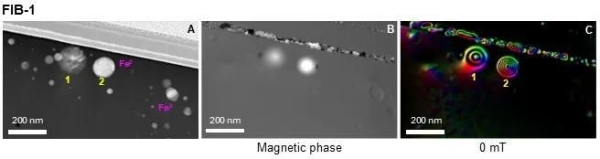
A research team from the Chinese Academy of Sciences has discovered γ-Fe in impact-glass particles from the Moon soil returned by Chang’e-6. This phase is generally stable only at temperatures above 900°C. Using off-axis electron holography, the team found that the magnetization directions inside some larger γ-Fe nanoparticles form a circular arrangement, creating a stable single magnetic vortex state that responds to changes in external magnetic fields. The study, published in PNAS, may provide insights into the analysis of ancient lunar magnetic field records and the magnetization mechanisms of lunar surface materials, but the sources of the Moon’s ancient magnetic field remain uncertain.
Source:中国科学院科研进展 · Read original
Leave a Reply